Setting the Precedent

Areas of Law Where Public Figure Status Matters

Living life in the public eye can result in both benefits and difficult obstacles in certain areas of the law. An individual’s status as a public figure is extremely notable in invasion of privacy and defamation cases. For celebrities, the right to publicity also comes into play. FindLaw.com defines the right to publicity as “an individual’s right to control and profit from the commercial use of his/her name, likeness and persona.” 

In 1988, singer, songwriter, and actress Bette Midler benefited from this right in her complaint against Ford Motor Company. Ford used a voice impersonator of Midler in one of their commercials after Midler refused to be in the commercial herself.  Midler v. Ford Motor Co. found that using an imitation of a celebrity’s “distinctive and widely known” voice without their consent to sell a product constitutes appropriation (Midler v. Ford Motor Co. – 849 F.2d 460 (9th Cir. 1988). In this case, Midler’s status as a celebrity or public figure made it easier for her to claim that her right to publicity was appropriated.

On the other hand, those deemed public figures in a court of law have a higher burden of proof in defamation and invasion of privacy lawsuits.

The Laws and Precedents Surrounding Compensation for NCAA Athletes

In 1984, Holt v Cox Enterprise set the precedent that an athlete will be considered a public figure or a private citizen on a case by case basis. This decision came about after University of Alabama football player, Darwin Holt, was involved in an on-field incident in which an opposing player sustained several serious injuries.

Holt was subsequently the subject of various articles published by major media outlets that he claims painted him in a bad light and invaded his right to privacy. The defendants in the case argued that Holt was a public figure due to his stardom at Alabama, and that he could not show the “requisite degree of actual malice necessary to hold them liable for their statements” (law.justicia.com). The court ruled in favor of Cox Enterprise and also found that a college athlete’s status as public or private should be determined on a case by case basis.

On the surface, this law is arguably ethical as it leaves the court the ability to account for the many differences between college athletes. However, as other laws regarding NCAA athletes are in the process of being changed, this law might require a deeper look.

In 2014, UCLA basketball star Ed O’Bannon filed a lawsuit against the NCAA in which he alleged that restricting student athletes from payment for the use of their names, images, and likenesses is an “illegal restraint of trade under Section 1 of the Sherman Antitrust Act” (O’Bannon v. NCAA). However, the court ruled that allowing student-athletes to receive compensation not connected to educational expenses was “not an appropriate alternative since it would defeat the student-athletes’ status as amateurs,” (Lexis Nexis). In 2016, this case made a bid for the Supreme Court, but was rejected.

2019 is seeing a serious push towards the payment of NCAA athletes, but the states involved so far are each pushing unique legislation. Without a national law to govern this matter, various issues are bound to arise.  
Where the Law is Headed

In September 2019, California Governor Gavin Newsom signed Senate Bill 206 into law. The Fair Pay to Play Act “permits college student athletes to benefit financially (for example, from endorsement deals) for their names, images, and likenesses while still in school,” ( Senate Bill (SB) 206).

LeBron James of the Los Angeles Lakers has long been outspoken in support of the compensation of NCAA athletes. James hosted California Governor, Gavin Newsom, on HBO’s “The Shop” where Newsom signed the “Fair Pay to Play” bill into law.

Senators in other states are working to pass similar legislation that would allow college student-athletes to make a profit while they are enrolled. 

Darren Heitner, founder and attorney at Heitner Legal, is working in Florida on legislation that will allow student athletes to profit off their name, image and likeness. Heitner recently participated in a Sports Law Roundtable at Hofstra University, presented by the Hofstra Law’s Sports and Entertainment Law Society (SELS). Heitner draws several distinctions between Florida’s bill and the California bill that has already been signed. 

“One big distinction between our bill and that of the state of California is that we’re only talking about college athletes who are enrolled in institutions,” Heitner said. “We’re not saying that individuals who are not yet enrolled will be given this right of publicity to exploit commercially the use of their name, image and likeness.”

Heitner went on to explain the importance of this distinction, which is that boosters and schools will not be able to entice a prospective student with concrete information about future compensation. It is only when a student-athlete is enrolled in school that they will be able to benefit from their right of publicity.

The Florida bill also does not distinguish between junior colleges and 4-year colleges. In addition, Heitner says the bill will allow for any college athlete in the state of Florida to be represented either by a licensed Florida attorney or a licensed athlete-agent.

Also in attendance at the Hofstra SELS roundtable discussion was New York State Senator Kevin S. Parker. Parker represents the 21st district of New York which includes Flatbush, East Flatbush, Midwood, Ditmas Park, Kensington, Windsor Terrace, and Park Slope. Parker has proposed an equal pay bill for every student-athlete at senior colleges and universities across New York. If signed into law, this legislation would require 15% of a school’s total revenue be divided among every student-athlete at that school. 

“If you’re the starting quarterback or a reserve player on the women’s field hockey team, you get the exact same cut,” Senator Parker said.

To rationalize this equal pay proposal, Senator Parker’s bill also allows college athletes to profit off their name, image, and likeness through endorsement deals separate from university compensation. 

Legal/Ethical Implications of the Changing Laws 

If Florida, New York, and more states throughout the country pass legislation similar to that of California, various ethical and legal implications can result. Furthermore, while the proposed legislation in Florida and New York covers the same issue, the various distinctions between the bills can also raise the ethical issue of unequal compensation for the same “job” across state lines.

As for legal issues, one would be the status of college athletes in a court of law. 

If considered a public figure, a college athlete has a larger burden of proof when bringing a defamation or invasion of privacy lawsuit. The benefit to being a private citizen can be seen in a court of law, where it becomes easier to win a defamation case as private citizens do not have to prove “actual malice” on the part of the defendant. 

As more laws might be passed to allow college athletes to be paid across the country, it would arguably be beneficial for a new precedent to be set for potential defamation and invasion of privacy proceedings that will be brought by these athletes.


What Others in the Field Are Saying

On the General Issue of NCAA Athletes Getting Paid:

“There are so many question marks out there.”

– Tim Tebow, on the future of the NCAA
Former University of Florida and NFL quarterback, Tim Tebow, expresses thoughts on California’s “Fair Pay to Play” Act.

In the above video, Tim Tebow highlights several issues that could arise without a universal law to govern the payment of NCAA athletes. He addresses the same fears that the NCAA itself is facing as different legislation is being pushed in different states.

Another public figure, Dallas Cowboys wide receiver Amari Cooper, expressed his position on California’s law in an interview with the Dallas Morning News.

“I think all student-athletes suffer from economic exploitation when it comes to the relationship between how much money the NCAA makes off their work and how much they get compensated for it,” said Cooper, former University of Alabama wide receiver. “I think it’s a good thing.”

dallasnews.com
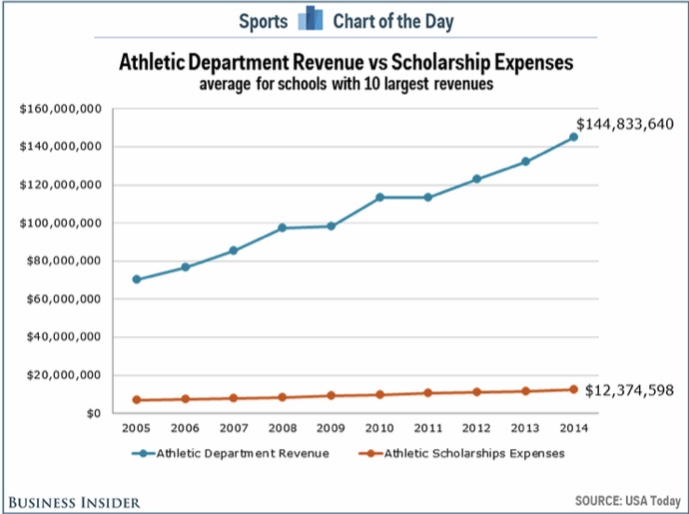
The above chart from Business Insider shows the large discrepancy between the revenue generated by certain schools and the amount those schools expense for athletic scholarships.

On the Status of NCAA Athletes as Public Figures vs Private Citizens:

Beneath the surface of new laws that will allow for the compensation in the NCAA are the ethical and legal implications of such a decision. Stephen Silver, an associate attorney at Ogletree Deakins specializing in sports law, does not foresee change when it comes to college athletes and determining their status as private citizens or public figures. He notes that star athletes, whether they are paid or not, are public figures in a court of law.

Silver draws on the example of UCLA gymnast Katelyn Ohashi, who gained a large following after a video of her perfect floor routine went viral in 2019.

With this larger amount of fame could potentially come the price of a larger burden of proof in a defamation or invasion of privacy case. And while Ohashi might not have initially sought the amount of notoriety she has received, Silver argues that by choosing to participate in UCLA gymnastics, a widely acclaimed college athletics program, she forfeits any potential claim to be a private citizen.

“Once that video went viral and had millions and millions of views, arguably she’s become a public figure.” Silver said. 

Ohashi herself would likely agree that she is a public figure; not only for her viral floor routine, but for her many media appearances and endorsement deals that followed.

Katelyn Ohashi has contributed to her public figure status through many different means, including her public support of California’s Fair Pay to Play Act.

What is missing from this analysis is whether it is ethical for another UCLA gymnast to be deemed a private citizen simply because their video on the UCLA Gymnastics Twitter page might not have as many views as Ohashi’s. 

American University law professor, Claire Griggs, believes that athletes like Ohashi make conscious decisions to be in the public eye.

“While it’s inconsistent, and the law doesn’t like inconsistencies, in this case, I think it would be ethical for one member to be a public figure while others remain private citizens,” Griggs said. “Ultimately, there is a matter of choice.”

Create your own website, free on WordPress.com.Create your own website.
Start free